
P16 - A digital textbook program has two parts
AI Textbook is an e-textbook with access to a knowledge base through an LLM translator. Its two parts, the text and the LLM knowledge base, do not have to be co-located.
In my last post, I introduced the idea of digital textbook programs (DTPs) as a practical way to use LLMs in teaching while avoiding their most serious limitation: hallucinations. The key insight was that LLMs should not be treated as omniscient tutors, but as interfaces to carefully constrained, reliable knowledge bases.
At the time, I assumed that a digital textbook program must be fundamentally different from conventional textbooks delivered in static formats such as PDF or Kindle. If the medium was new, I reasoned, then the authoring tools must also be new.
That assumption turned out to be wrong.
A detour through Godot
To test the idea, I experimented with Godot as an authoring platform. For interactive storybooks, Godot worked surprisingly well. It is easy to learn, flexible, and well suited to combining text, images, animation, and interaction.
However, it quickly became clear that Godot is not suitable for writing engineering textbooks. The most serious limitation is that its text panels do not support LaTeX. As a result, mathematical expressions must be rendered as image files—a deal-breaker for any serious technical subject. There are other issues as well, but the lack of native LaTeX support alone is sufficient to rule it out.
This forced me to step back and re-examine a more fundamental question.
Rethinking the “digital” in digital textbooks
Does a digital textbook program really need to be fundamentally different from today’s textbooks?
I now think the answer is no.
At least the textbook component of a DTP can be as conventional—and as boring—as a PDF file or a Kindle book. We already know how to write textbooks in these formats, and the tools are mature, robust, and well understood. Reinventing that part of the workflow is unnecessary and, in hindsight, counterproductive.
What actually makes a DTP different is not the format of the text, but what the text is connected to.
Linking textbooks to knowledge bases
The essential ingredient of a DTP is a dense network of URL links embedded throughout the textbook. These links connect the reader to an external knowledge base—most likely hosted on a server—that is tightly scoped to the relevant chapter or section.
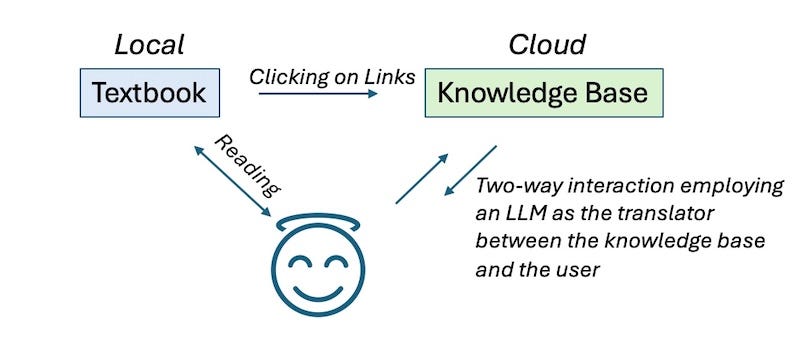
When a reader clicks such a link, their question is automatically contextualised. The system already knows where in the book the reader is, and therefore what material the question must relate to. This makes it possible to keep the knowledge base small, precise, and reliable, while still offering an interactive, conversational experience via an LLM.
In this architecture, the textbook remains static—but the learning experience does not.
Practical and commercial advantages
This approach has an important practical benefit: it allows authors to focus their effort where it matters most—the knowledge base. The textbook itself can be produced using conventional tools, while innovation is concentrated on structuring, validating, and maintaining the underlying domain knowledge.
It also opens up a clean monetisation model. The textbook component of the DTP can be distributed freely, but access to the knowledge base can be restricted. Readers may be required to pay for interactive features, advanced queries, or extended explanations, while the static text remains openly accessible.
In short, we do not need to reinvent textbooks to build digital textbook programs. We only need to connect them intelligently to reliable knowledge—and let LLMs do what they are best at: communication, not authority.
.